
Patera: "Restoration means making the past understandable to those who observe it today"
During TourismA 2026, Dr Anna Patera, Director of the Advanced Training School of the Opificio delle Pietre Dure, offered a fascinating insight into a restoration project that is as complex as it is meaningful: the restoration of the Garni mosaic in Armenia. This is not merely a technical intervention, but also a cultural one, as it allows us to rediscover a work that still has much more to tell us than may initially appear.
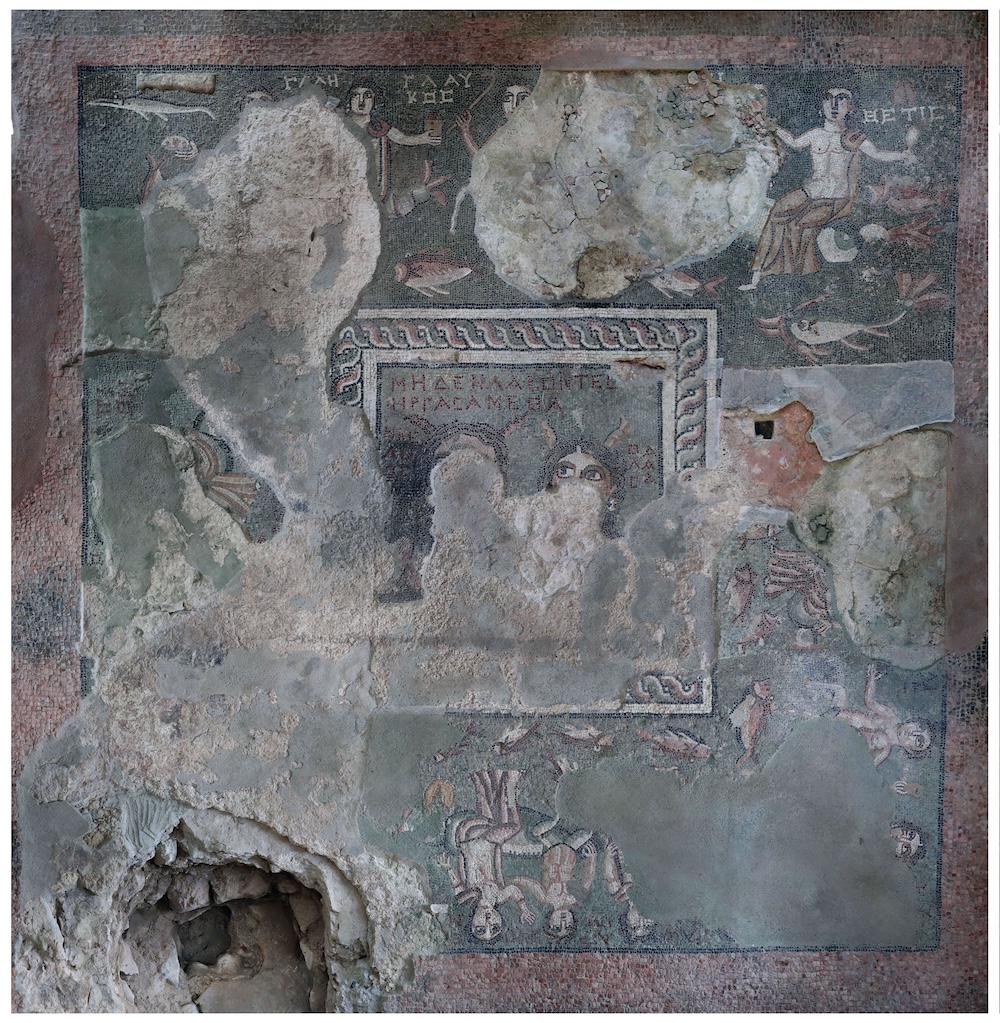
The mosaic currently being restored by the Opificio delle Pietre Dure.
The mosaic is located within a site of exceptional historical importance, dominated by a Roman-era temple that represents the focal point of the area. Alongside it, the baths provide clear evidence of the spread of Roman cultural models to distant territories such as Armenia. This is not simply a matter of architecture: it is evidence of a dialogue between cultures. Today, the site is recognised as a UNESCO World Heritage Site and is considered a symbol of Armenian national identity—a place where local history and external influences come together in a unique way.
On April 28, restoration work began on the mosaic in the baths dating back to the 3rd century AD at the Temple of Garni. The work is being led by experts from the Opificio delle Pietre Dure in Florence, as part of a broader project funded by the Italian Agency for Development Cooperation (AICS) and carried out in collaboration with the Ministry of Education, Science, Culture and Sports of the Republic of Armenia. During a visit to the Garni Historical and Cultural Reserve, the Italian restorers, accompanied by their Armenian colleagues, carried out an initial phase of preliminary studies and sampling before moving on to the delicate operational stage.
The restoration, expected to take approximately three years, will include both the conservation of the mosaic floor and a series of major structural interventions on the entire bath complex. The mosaic has attracted considerable attention from modern scholars because it represents the easternmost known occurrence of the figures of Oceanus and Thalassa. This makes it particularly important for understanding the spread of Roman iconographic models.
The baths and the context of the mosaic
The mosaic is located in a small apsidal building belonging to a bath complex. The sequence of rooms follows the traditional Roman layout: from the frigidarium, with cold water, bathers gradually moved towards pools with increasingly warmer temperatures. The relatively small size of the structure suggests that it was intended for exclusive use: these were not public baths, but were probably reserved for members of the Armenian royal dynasty and their court. It was therefore a summer residence, where the mosaic also had a representative function.
A precious work rich in meaning
Covering approximately 9 square metres, the mosaic is striking for its refinement. Its green background evokes the waters of the sea, creating an immersive effect. At the centre are personifications of Oceanus and the Sea, surrounded by marine figures in a lively and dynamic composition. Fish and aquatic elements are arranged with great care, creating a strong sense of movement and fluidity.
The theme is typically Roman: marine scenes were widely used in mosaics decorating bath complexes. The mosaic is made exclusively from local stone tesserae, with no glass paste. Its colour palette was carefully designed to make the figures stand out and create a sense of depth. The tesserae range in size from around 5 centimetres to just a few millimetres and are arranged with remarkable regularity. This precision contributes to the overall harmony of the composition and the clarity of the imagery.
The mystery still to be solved
One extraordinary feature is the presence of Greek inscriptions, which clearly identify the figures depicted. This is an exceptional characteristic that makes the mosaic even more valuable to scholars.
One of the inscriptions in ancient Greek, positioned above the main figures, is particularly enigmatic: “We worked without ceasing, without receiving any compensation” (or “without being given anything”).
It may be interpreted as a reference to the tireless and unpaid work of the sea for the benefit of humanity. Alternatively, it could be read as an ironic comment by the artists who created the mosaic and were supposedly not paid. The latter interpretation, however, raises questions, given that it seems unlikely that such an important patron would have allowed an inscription with such a meaning to remain in a royal residence.
Another possible interpretation is “without receiving anything in return”, understood as an offering made to the royal family.
The inscriptions are also oriented so that they can be read from different points within the space, probably by those who used the baths: an educated and cultured audience capable of understanding their meaning.
The mosaic is in poor condition
Despite its importance, the mosaic is currently in critical condition. It shows alterations, missing tesserae and widespread signs of deterioration, with some areas particularly compromised.
For this reason, the work of the Opificio delle Pietre Dure is currently focused on a careful phase of study and analysis carried out directly on site. This preliminary investigation is essential to designing an effective restoration that respects the original work.
The goal, however, is not simply to conserve the mosaic, but to ensure its sustainable management over time. This means not only stopping deterioration, but also preventing environmental risks and establishing continuous monitoring systems. It is a modern approach that considers restoration as part of a broader strategy of conservation and enhancement.
Enhancement and communication: an open challenge
One aspect highlighted by Anna Patera concerns the visitor experience. The mosaic often remains marginal to the overall tour, partly because of inadequate signage and interpretation.
The work of the Opificio also aims to change this, transforming the mosaic into a central element capable of attracting attention and stimulating curiosity. In collaboration with local institutions, a communication and enhancement strategy is being developed for a contemporary audience.
Because restoring does not simply mean preserving the past. It also means making that past alive, accessible and understandable to those who look at it today.
Last update
20.08.2026