
Cabasino: “There can be no heritage protection without the involvement of local communities"
A summary of the speech by Emilio Cabasino, an official of the Italian Agency for Development Cooperation (AICS) and an expert in cultural cooperation.
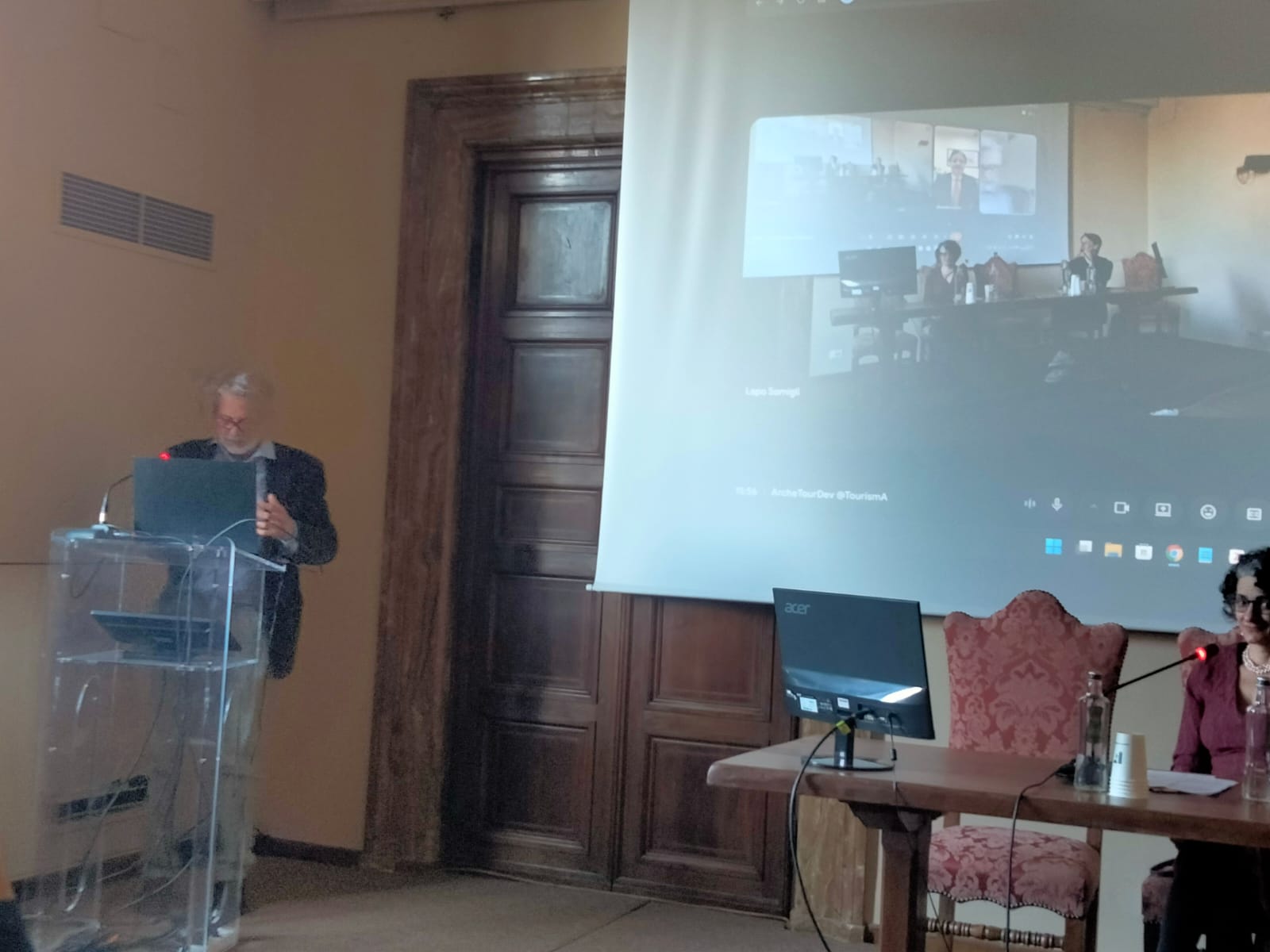
Emilio Cabasino during his speech at TourismA 2026.
Cabasino offered a comprehensive overview of the main themes that emerged during the conference, focusing in particular on the relationship between cultural heritage and development cooperation.
A tool for development
Cabasino highlighted the value of the historical ties between Italy and Armenia, longstanding connections that continue to provide an important foundation for joint cultural projects. This reference to the past was linked to a reflection on the present, showing how current initiatives are being carried out at very different sites, each with its own specific challenges and needs in terms of conservation, management and enhancement.
A central theme was cultural cooperation as a tool for development. In this context, the archaeologist emerges as a particularly important professional: someone able to adapt to complex environments and equipped with organisational and operational skills that are essential in international projects. This versatility is also reflected in institutional settings, which are often complex and not always straightforward.
Cultural heritage is a multifaceted resource, capable of acting on several levels: symbolic and identity-related, but also practical and economic. In this regard, the importance of relational and social dimensions was emphasised, including informal moments that encourage dialogue and help overcome linguistic and cultural barriers.
Another significant point concerned the relationship between physical scale and cultural value. Even relatively small heritage assets can possess extraordinary significance, challenging a contemporary perspective often focused on quantity rather than quality. This approach calls for a renewed appreciation of cultural experiences, based on depth rather than scale.
The importance of “border territories”
Particular attention was devoted to so-called “border territories”, where cultural heritage can play an even more significant role. At a time marked by new forms of closure and restrictions on mobility, heritage continues to serve as a tool for dialogue and connection. The history of the Mediterranean, and of Italy in particular, demonstrates how civilisations have developed through continuous processes of exchange and cultural interaction.
Communicating what we do
In terms of heritage enhancement, Cabasino highlighted the need to address the challenge of communication. Not every heritage site is immediately attractive to the general public: structures made of raw earth or less visually striking archaeological remains require appropriate interpretive tools.
In this context, new technologies – from virtual reconstruction to immersive experiences – represent a fundamental resource for restoring meaning to sites and making them more accessible to visitors.
The Italian model
Cabasino also recalled the role of the Italian Agency for Development Cooperation (AICS), established following the 2014 reform and operational since 2016. Initially, culture was not an independent thematic area within the agency. Over the years, however, awareness of its strategic importance in development processes gradually grew, leading to a more structured recognition of the sector.
The Italian cooperation “system” is based on a network of collaborations involving universities, local institutions, international research centres and associations. Within this framework, some projects stand out as successful examples of synergy, demonstrating how cooperation can work in practice through shared approaches and activities.
Local communities are the “true custodians”
The role of local communities remains fundamental. Heritage conservation cannot be separated from the direct involvement of the people who live in the areas concerned. Only when cultural value is recognised and embraced at community level can long-term protection be ensured. Without this awareness, even the most structured interventions risk proving ineffective.
The need for innovative “cultural” indicators
In conclusion, Cabasino stressed the need to strengthen evaluation tools for the cultural sector within development cooperation. Unlike areas such as healthcare, education or the environment, the results of cultural interventions are less immediately quantifiable. This creates a need to develop indicators capable of demonstrating the economic and social value of heritage as well.
Culture is not an isolated field, but a cross-cutting dimension that affects every area of development. Understanding the cultural context of a community means laying the foundations for interventions that are more effective, sustainable and lasting.
Last update
20.08.2026