
Emanuela Daffra: “Culture will save us, not beauty"
Summary of the speech by Emanuela Daffra, Superintendent of the Opificio delle Pietre Dure, at the meeting “ARMENIA: ARCHAEOLOGY, COOPERATION AND DEVELOPMENT”, TourismA, Florence, February 28, 2026.
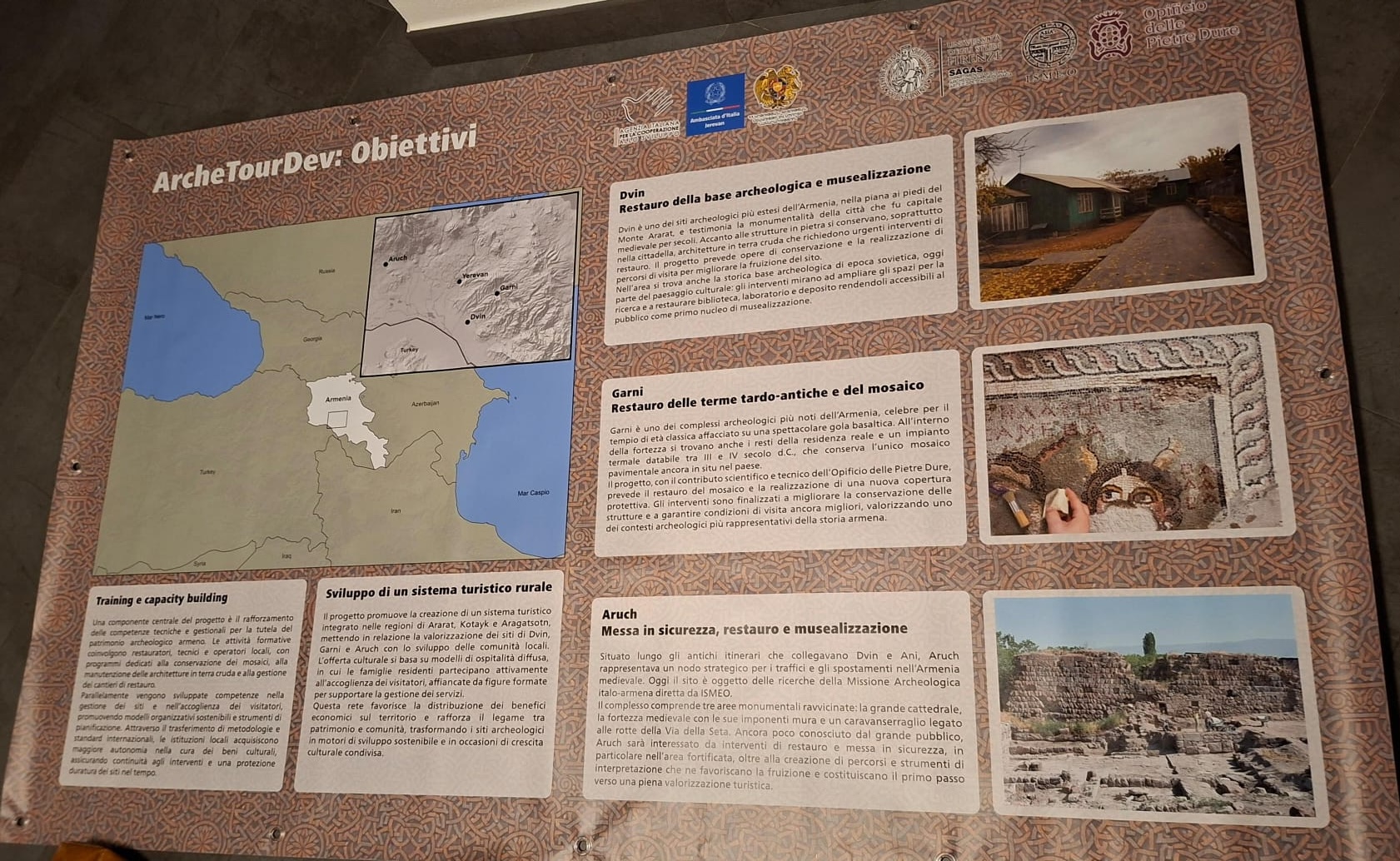
An image of the ArcheTourDev stand at TourismA 2026, featuring the mosaic currently being restored by the Opificio delle Pietre Dure (OPD).
Emanuela Daffra, art historian, senior official at the Italian Ministry of Culture and Superintendent of the Opificio delle Pietre Dure, explained why the Florentine institute is involved in the ArcheTourDev project, which also includes the restoration of a mosaic at Garni, Armenia. Daffra outlined the cultural and scientific reasons that led the Opificio to take responsibility for the project and explained why it was chosen as a partner by the Sagas Department of the University of Florence, the lead institution of ArcheTourDev.
A story that began long ago
The Opificio delle Pietre Dure, founded in 1588 by Grand Duke Ferdinando I, was originally established as a highly prestigious workshop, where extraordinary craftsmen created works of exceptional quality, prestige and cost. Many of these masterpieces are now housed in the Uffizi Gallery.
Over time, the Opificio gradually changed its role. In particular, from the late nineteenth century onwards, as commissions declined, its expertise was progressively redirected towards restoration.
As early as the end of the nineteenth century, the institute carried out major restoration projects, including work on the dome of the Baptistery. This helped establish an increasingly well-documented and informed approach to the treatment of artworks.
A decisive turning point came with the 1966 Florence flood, when thousands of works of art were damaged by water, mud and fuel oil. This crisis highlighted the need for rapid intervention, but also for rigorous methods based on a thorough understanding of materials and how they behave. From this experience emerged a scientific approach to restoration, based on collaboration between different areas of expertise. This process led, in 1975, to the creation of the modern Opificio, which has since become an international reference point for conservation.
From past experience to present-day expertise
It is precisely this approach, developed by the Opificio through centuries of experience, that guided its intervention in Armenia. Initially, the Opificio was expected to provide only project-planning support; its role subsequently evolved into direct involvement in the field.
The Garni site, a small thermal complex associated with the residences of Armenian rulers, presents particularly complex conditions: an extreme climate, seismic activity and ongoing deterioration. Here, the Opificio applied its established methodology, avoiding empirical or subjective approaches and focusing instead on scientific analysis and shared solutions.
A project built on sharing
Equally important to the success of the project is the work with local professionals, through dialogue between Italian conservators and specialists from the area, with the aim of transferring expertise and building an autonomous capacity for heritage protection.
The value of the project, in fact, goes far beyond the individual restoration. Caring for such a significant heritage site means initiating a broader cultural process that strengthens Armenian awareness of its heritage, supports tourism and contributes to the training of local professionals.
What the Opificio is undertaking is therefore not simply a service to an artwork, but also to the communities who live around the site and to its visitors, based on the conviction that culture, even before beauty, is a fundamental tool for everyone's future.
Last update
20.08.2026